



Procurement in the trades has always been complex work. Managing supplier relationships, securing competitive pricing, coordinating material requests across active jobs, and ensuring the right equipment arrives when it’s needed are far from simple tasks. They depend on experience, sound judgment, and a deep understanding of the market.
What’s changed isn’t the expertise required. What’s changed is how much of that work the market now demands, and how much more sophisticated the tools available to support it have become. Procurement-as-a-Service represents that evolution, and the contractors embracing it are finding themselves with a meaningful edge.
The Problem with Transactional Purchasing at Scale
Most MEP contractors built their procurement around relationships, and those relationships still matter. A local supplier who knows your business, picks up the phone, and can pull from regional inventory on short notice is worth protecting. The challenge is that as projects multiply and teams grow, relationships alone can’t carry the full weight of purchasing. Consistency breaks down. Pricing drifts. The value of those partnerships gets undermined by the chaos around them.
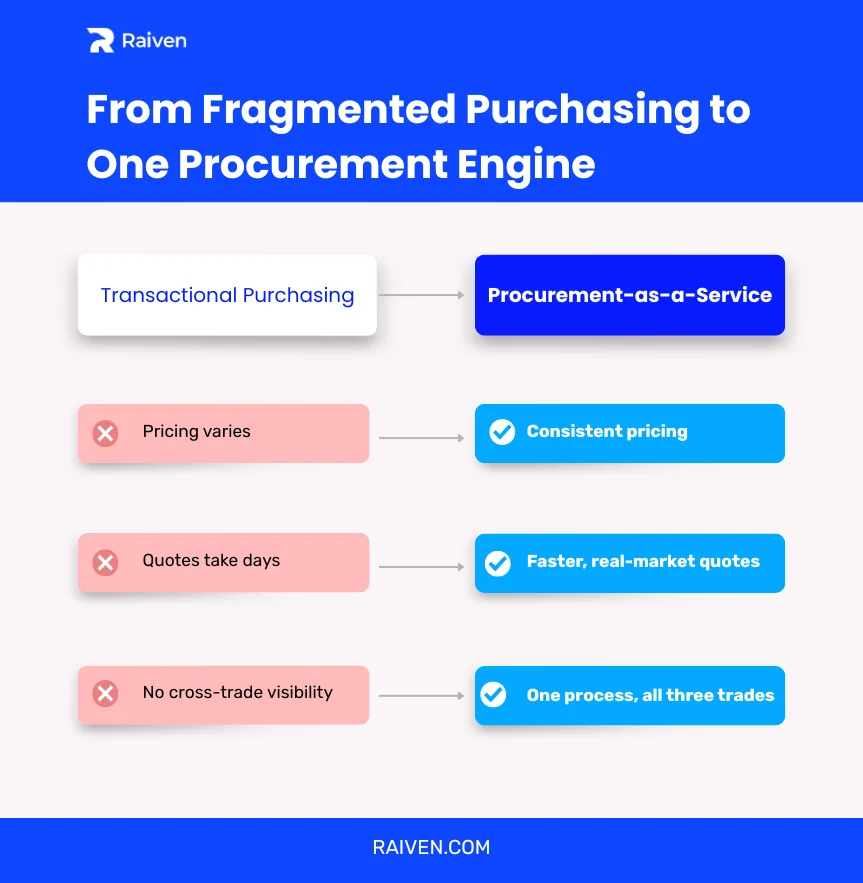
When you’re running electrical, mechanical, and plumbing across multiple active jobs, often out of multiple branches, purchasing fragments. The same material ends up at three different prices depending on who ordered it, which branch submitted the request, or which rep happened to pick up the phone. There’s no visibility into whether the number you’re building a bid around reflects where the market actually sits today.
The result is margin erosion that’s hard to see until it’s already happened.
What Procurement-as-a-Service Actually Means
Procurement-as-a-Service isn’t a software category or a buzzword, it’s a structural shift in how a contracting company approaches buying.
In a Procurement-as-a-Service model, procurement stops being reactive (someone needs something, someone else tracks it down) and becomes a coordinated capability that runs alongside how the business already operates. Material requests still come in the same way they always have, from a field tech, a foreman, whoever’s on the job. What’s different is what happens next.
Raiven’s platform handles the sourcing, quoting, and supplier engagement on the back end through Raiven Assist, an AI-powered procurement tool that works however your team already communicates. Project teams don’t change how they submit requests. The process just gets faster, more consistent, and more accurate.
Three Places the Difference Shows Up
Quotes come back faster and more complete. When material requests move through a coordinated process, with the right suppliers engaged and pricing checked across the network, the turnaround tightens. Less time chasing quotes means more confidence that the number you’re bidding around reflects real market conditions, not last quarter’s assumptions.
Pricing travels with every request. Pre-negotiated pricing with preferred suppliers, embedded across mechanical, electrical, and plumbing categories, means the right price follows each request regardless of who placed it or where. That kind of consistency is what makes margin protection possible at scale, not just on individual jobs, but across a whole project portfolio.
Buying power compounds. Your supplier relationships don’t go away, they get stronger. Raiven is built to work with the suppliers you already trust, bringing them into a unified process that gives you better visibility and consistency across every order. Individually, even a large contractor has a ceiling on the leverage they can bring to supplier negotiations. Raiven aggregates spend across its contractor network to unlock pre-negotiated pricing that reflects collective volume — giving individual contractors access to rates typically reserved for buyers much larger than themselves. In a market where material costs keep climbing, that difference adds up fast.
What Doesn’t Change
Raiven isn’t a replacement for the procurement knowledge that already exists inside your company. The supplier relationships, the material expertise, the understanding of what a specific job actually needs — that stays with the team that’s been building it.
What Raiven adds is a procurement model that makes that expertise scale: consistent pricing, faster sourcing, and visibility into how material costs are moving across the trades, not just what your own purchasing history shows.
The Competitive Reality
The contractors gaining ground right now tend to share a few things. They’re running tighter operations. They’re making faster, better-informed decisions. And they’ve stopped treating procurement as overhead and started treating it as a competitive lever.
When quotes come back faster, bid pricing is calibrated against real market data, and material costs reflect genuine buying leverage — the cumulative effect on margin and competitiveness is significant. That’s what the shift from transactional purchasing to Procurement-as-a-Service actually delivers. Not a different philosophy. A better-equipped operation.
Raiven serves MEP contractors with a procurement platform built specifically for the trades, spanning quotes, material requests, and supplier network pricing across mechanical, electrical, and plumbing. Learn more at raiven.com.