


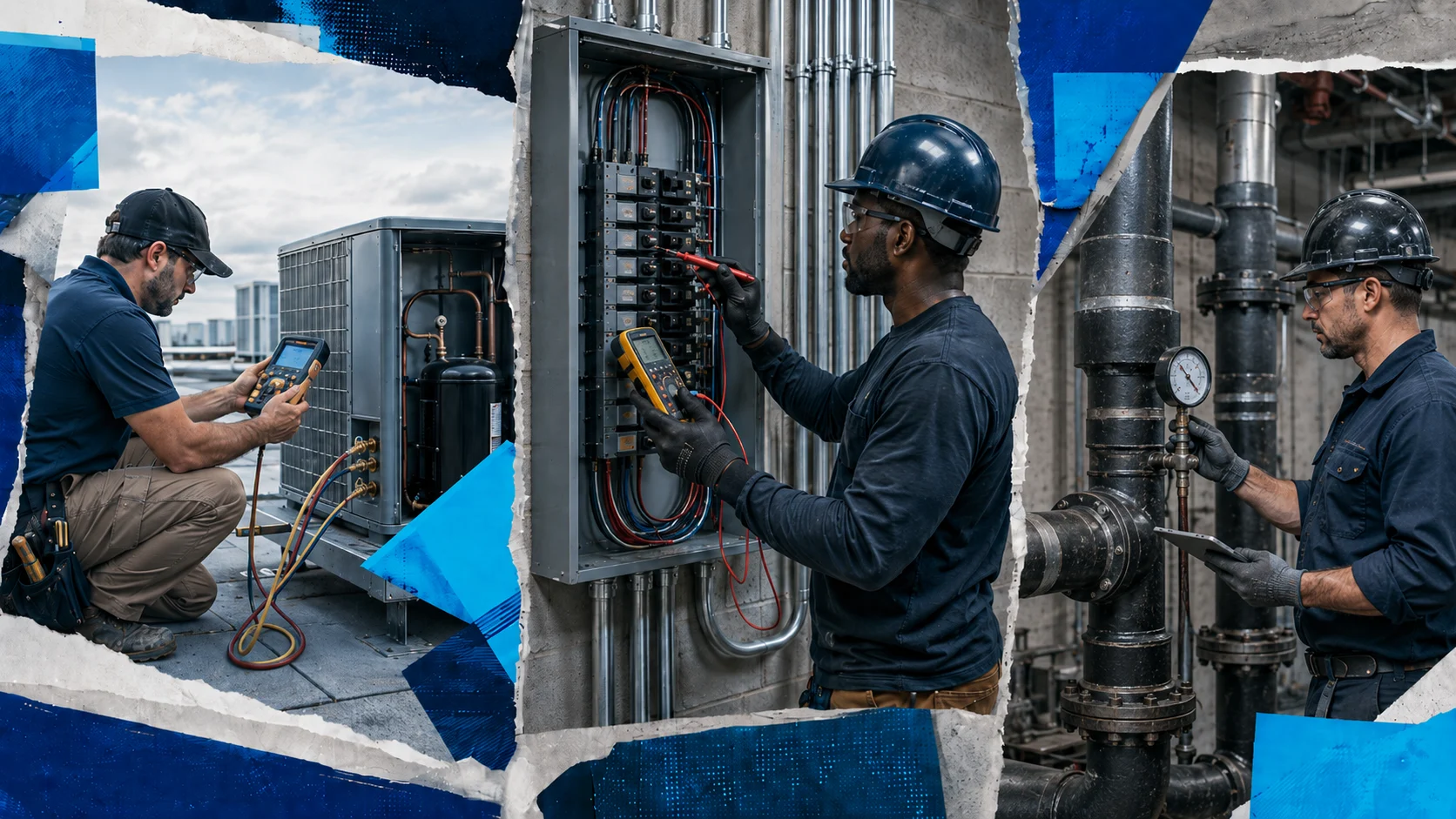
On a multi-trade job, the same building can have four different buying crises running at the same time.
An HVAC service tech is on-site with a compressor down and a commercial customer losing a day of operations. He needs a Copeland ZR54K3E or an approved equivalent. Today. The usual distributor is out, and no one on the team has visibility into who else carries it at that volume in the region.
Two floors up, the electrical PM just found out the Square D 200A panel she thought was ordered six weeks ago is still sitting in a quote inbox. Nobody followed up. No one flagged the mismatch between what was quoted and what was actually purchased. The crew shows up Monday either way.
Down the hall, a plumbing coordinator released rough-in material for the next phase, but ordered the wrong fitting spec because the approved substitute from a field RFI never made it back to procurement. Now someone has to source a replacement fast, before it becomes a schedule problem.
Every trade buys differently and that’s where it gets complicated
Electrical, plumbing, HVAC, and mechanical teams work with different suppliers, different lead times, and different consequences when something goes wrong. An urgent service part, a phased material release, and a long-lead equipment package are not the same buying decision. They need different workflows, different approvers, and different supplier logic.
But most multi-trade contractors are managing all of it through the same patchwork of texts, emails, supplier portals, and tribal knowledge. It works when the company is small enough for everyone to know who handles what. It starts to break the moment you add another branch, another trade, or another layer of coordinators who weren’t there when the supplier relationships were built.
And when it breaks, it usually breaks quietly. A quote sits unanswered. A lead time shifts after the order is placed. A spec change doesn’t reach the person placing the order. None of it shows up on a P&L until the job is already behind.
The right call isn’t always the cheapest one
In the field, the right call means the option that protects the job. For the tech with a customer down, it’s whoever has the Copeland ZR54K3E in stock and can get it there today. For the PM managing a long-lead package, it’s the supplier who actually hits the delivery window so the crew isn’t standing around. For the plumbing crew sourcing a substitute fitting, it’s who has the right product in the right quantity at the right time.
Price matters. But speed, availability, proximity, and reliability often matter more, and the right weight of each changes by trade, by job, and by the hour.
The contractors who buy smarter also quote smarter. When you have visibility into supplier options beyond the two or three vendors you typically call, you gain the leverage to negotiate on cost without trading away delivery time, lead time, or service quality. That margin protection starts at procurement, not at the bid.
Where Raiven comes in
Raiven acts as an always-on procurement operation for contractors who can’t afford to staff one. Teams can request quotes, source parts, and manage supplier decisions through text, email, or call.
Raiven brings visibility to the quoting process so you can catch mismatches, flag long lead times, and identify equipment or material issues before they become job-site problems. Every line item is organized and trackable, from who the quote was sent to, through identifying gaps and inefficiencies, all the way into the buyout.
Raiven Best Value™ evaluates supplier options across the variables that actually matter in the field: urgency, proximity, availability, and price, so contractors aren’t just picking the cheapest option, they’re picking the right one. And by expanding supplier access beyond the usual network, Raiven gives teams the leverage to optimize cost without sacrificing the things the field actually depends on.
For multi-trade contractors, that matters because the right answer changes by trade. Raiven handles the complexity without forcing every trade to work the same way.
Because on a multi-trade job, you don’t have one procurement problem. You have several, and they all need to resolve before Monday.
If your operation runs across multiple trades, Raiven was built for exactly this. See how it works at Raiven.com.
Raiven is an agentic procurement platform built for the trades. HVAC, electrical, and multi-trade contractors use Raiven to source smarter, buy at better prices, and keep jobs moving.